

Building the Future of Indonesian Cocoa through Participatory Foresight INDOKAKAO Launches Participatory Prospective Analysis (PPA) Training to Support the Sustainable Cocoa Roadmap 2035
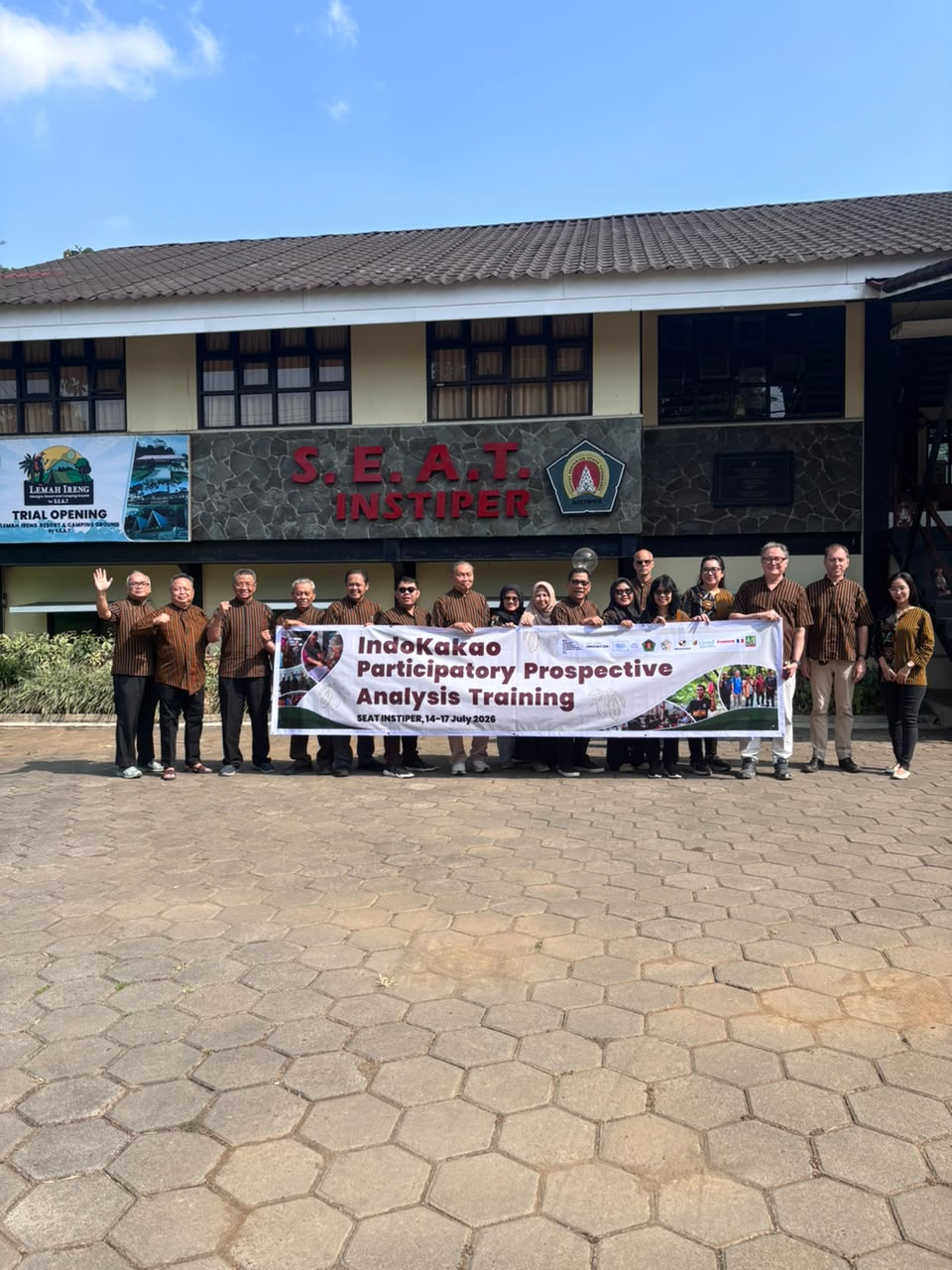
Yogyakarta – Responding to increasingly complex challenges facing Indonesia’s cocoa sector, the INDOKAKAO Program has initiated a new approach to planning the future of sustainable cocoa development through a Participatory Prospective Analysis (PPA) Training Workshop. Held at SEAT INSTIPER Yogyakarta, the three-day program brings together researchers, academics, development practitioners, and government representatives to strengthen national capacity in foresight analysis and collaborative strategic planning.
The activity forms part of the INDOKAKAO Program, funded by the Government of France and jointly implemented by CIRAD (Centre de coopération internationale en recherche agronomique pour le développement) and the Center for Sustainable Landscape Science (PSLB) INSTIPER. The training in SEAT INSTIPER represents an important milestone in preparing the implementation of a larger multi-stakeholder PPA workshop that will be conducted in Central Sulawesi, one of Indonesia’s most important cocoa-producing regions from 13 to 25 July, 2026..
Indonesia’s cocoa sector is entering a period of profound transformation. Global market dynamics, increasing sustainability standards, climate change, technological innovation, changing consumer preferences, and evolving regulations are reshaping how cocoa is produced, processed, and marketed. At the same time, producing regions such as Central Sulawesi continue to play a strategic role in national cocoa production, while Yogyakarta is emerging as an innovation hub for agroforestry, specialty chocolate, local processing, and value-added cocoa enterprises.
Recognizing these changes, the workshop encourages participants to move beyond conventional planning approaches that rely solely on historical trends. Instead, they are introduced to futures thinking and systems approaches that enable stakeholders to explore multiple possible futures, identify critical uncertainties, and develop adaptive strategies for long-term sustainable cocoa development.
According to the workshop organizers, the future of cocoa cannot be determined by productivity improvements alone. Sustainable development requires strong collaboration among government institutions, farmer organizations, cooperatives, financial institutions, universities, researchers, private companies, and civil society organizations. Building a common understanding among these actors is therefore essential for creating a resilient and competitive cocoa sector.
Throughout the three-day training, participants learn the principles and methodology of Participatory Prospective Analysis (PPA), an internationally recognized foresight approach developed by CIRAD to facilitate collective exploration of future scenarios. The training combines interactive presentations, systems analysis, structural analysis, stakeholder mapping, scenario building, and practical exercises using complementary foresight tools such as Backcasting, Future Triangle, Three Horizons, and Futures Wheel.
The workshop also serves as a preparation phase for implementing PPA in Central Sulawesi. Participants work together to validate stakeholder mapping results, identify drivers of change affecting the cocoa system, analyze relationships among strategic variables, and formulate alternative scenarios that will later be refined through a broader multi-stakeholder dialogue in Palu.
One of the expected outcomes is the development of a shared understanding of the opportunities and risks that may shape Indonesia’s cocoa sector over the next decade. Rather than producing a single prediction, the process encourages stakeholders to examine multiple plausible futures and identify strategies that remain effective under different conditions.
Beyond strengthening technical capacity, the initiative seeks to establish a network of Indonesian PPA facilitators capable of independently applying participatory foresight methods in future landscape and commodity development programs. This represents an important investment in institutional capacity and collaborative governance for sustainable agriculture.
Ultimately, the workshop is intended to become the starting point for preparing the Sustainable Cocoa Roadmap 2035 for Central Sulawesi and the Special Region of Yogyakarta. The roadmap is expected to provide strategic guidance for governments, development partners, farmer organizations, private companies, and investors in building a cocoa sector that is economically competitive, environmentally sustainable, socially inclusive, and resilient to future uncertainties.
Through this initiative, the INDOKAKAO Program demonstrates that preparing for the future of cocoa requires more than technological innovation—it requires collective intelligence, systems thinking, and strong partnerships among all actors across the cocoa landscape. By bringing together diverse stakeholders to jointly imagine, discuss, and shape the future, Participatory Prospective Analysis provides a practical pathway toward building a more resilient and sustainable cocoa economy for Indonesia.