

CIRAD and PSLB INSTIPER Apply Futures Analysis to Shape the Future of Cocoa Development in Central Sulawesi
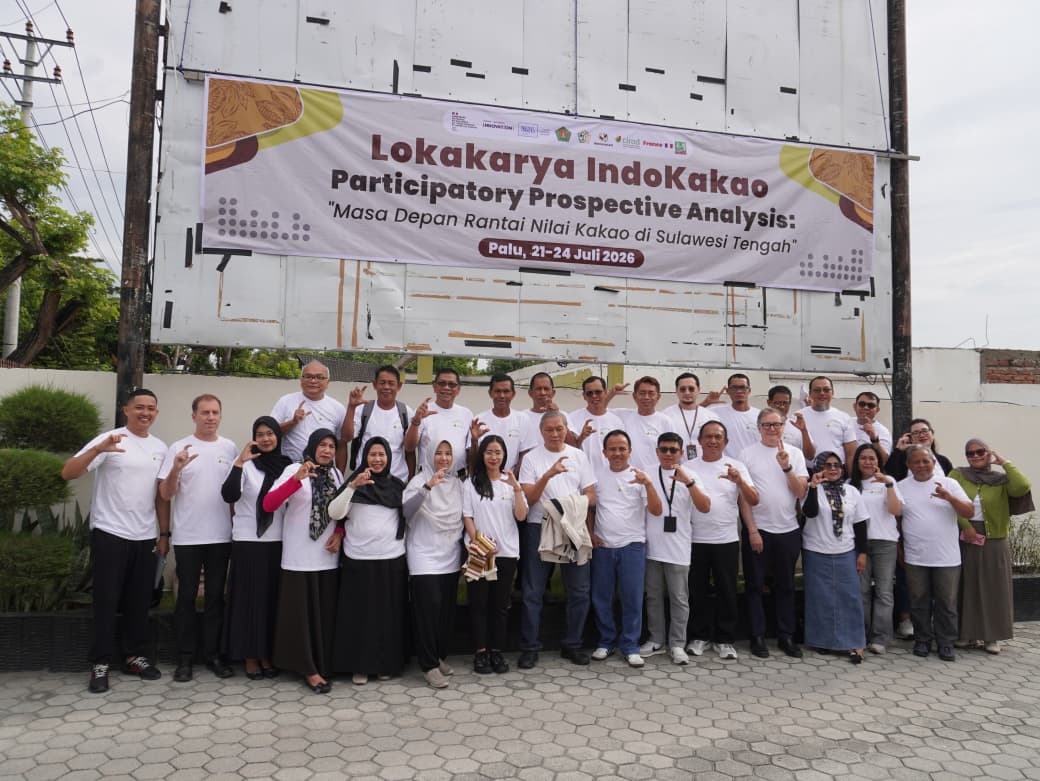
Palu, Indonesia, 24 July 2026 – The INDOKAKAO Program, a collaborative initiative between the Governments of Indonesia and France supported by CIRAD (Centre de coopération internationale en recherche agronomique pour le développement), has taken another significant step toward promoting sustainable cocoa development in Indonesia. From 21 to 24 July 2026, the program organized a Participatory Prospective Analysis (PPA) Workshop in Palu, Central Sulawesi, to explore future pathways for cocoa development and strengthen the long-term resilience of the province’s cocoa sector.
Held at the Swiss-Belhotel Silae Palu, the workshop brought together a broad range of key stakeholders representing the cocoa landscape. Participants included the Central Sulawesi Regional Development Planning Agency (Bappeda), Provincial Plantation Office, Cooperative and SME Office, Forestry Office and Forest Management Units (KPH), representatives of farmer and social forestry groups, cocoa enterprises and SMEs, financial institutions such as the Financial Services Authority (OJK) and Permodalan Nasional Madani (PNM), civil society organizations, and universities.
The workshop adopted the Participatory Prospective Analysis (PPA) methodology, a foresight approach developed by CIRAD to help stakeholders anticipate long-term change, address uncertainty, and jointly design adaptive development strategies. Rather than focusing solely on current challenges, participants explored multiple possible futures for the cocoa sector and examined how today’s decisions could shape the cocoa landscape by 2050.
The discussions began with a systems-based understanding of the cocoa landscape and its value chain, followed by the identification of key drivers influencing the future of cocoa development across social, economic, technological, environmental, and governance dimensions. Participants then analyzed a Business-as-Usual (BAU) future, envisioned desirable and undesirable future conditions, and explored potential disruptive events or “future surprises” that could significantly transform the cocoa system.
Building upon these analyses, the multi-stakeholder forum developed several alternative scenarios describing how the cocoa sector could evolve from its current situation in 2026 toward different futures by 2050. These scenarios will provide strategic inputs to the preparation of the Central Sulawesi Cocoa Development Roadmap, supporting evidence-based planning and adaptive policy development for a more resilient, competitive, and sustainable cocoa sector.
The workshop featured technical expertise from CIRAD and was facilitated by a team of five professional facilitators from the Center for Sustainable Landscape Science (PSLB), INSTIPER Yogyakarta, and Tadulako University (UNTAD). The collaboration reflects a shared commitment to strengthening local capacities in strategic foresight and participatory planning for sustainable landscape development.
Through the application of Participatory Prospective Analysis, the INDOKAKAO Program demonstrates that the future of cocoa development extends beyond increasing production. It requires building resilient landscapes, competitive value chains, inclusive institutions, and adaptive governance systems capable of responding to climate change, market dynamics, technological innovation, and emerging global challenges. By fostering collective foresight and strategic collaboration among stakeholders, the initiative aims to support a cocoa sector that is more sustainable, resilient, and capable of improving the livelihoods of farming communities across Central Sulawesi.